
1. It’s Still Early Days for AI Attackers … but Expect a Big One in 2026
McKinsey says that 88% of organizations are using AI in at least one area, but that <10% in each business function say they’re scaling an agentic AI system. Less than 2% say there’s fully scaled AI agent usage. We see this pattern in most of the breathless surveys that are published every week: everyone’s doing something with AI, but not a lot. There’s inertia: the vast majority of GDP still happens in bog-standard software systems, so that’s where the majority of value is to be stolen. It’s still early days for AI attackers.
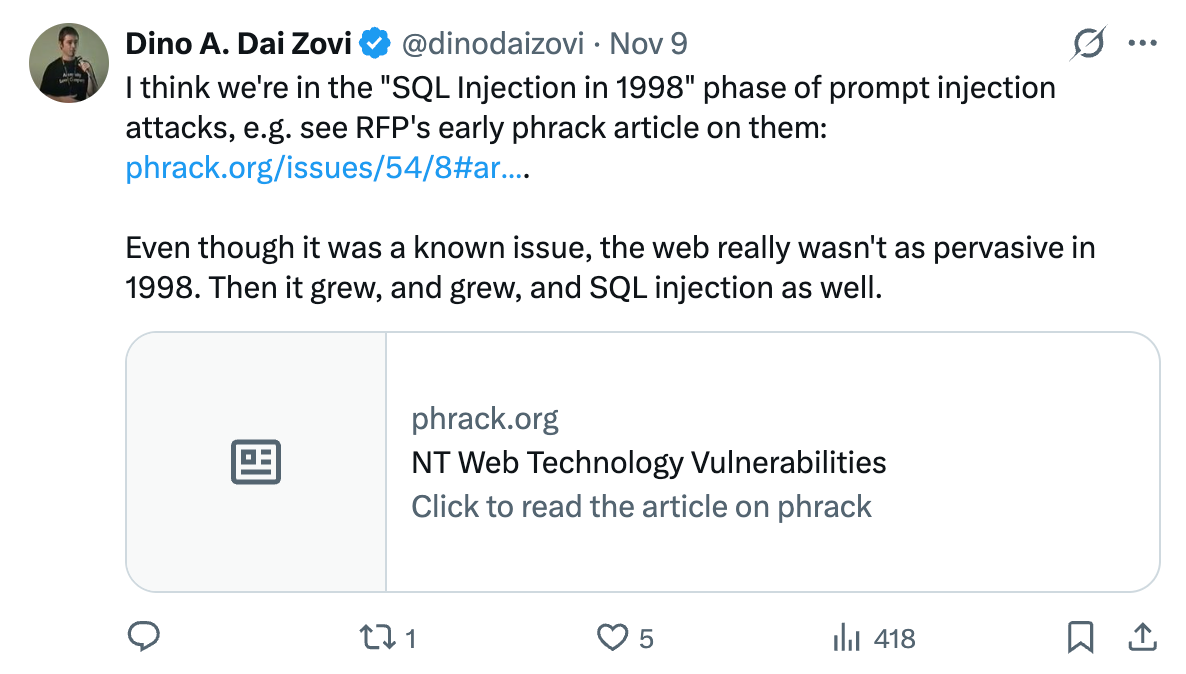
It’s game theory. “Attackers have to retool and retrain. It's not worth the effort until target prevalence is sufficiently high,” says Dino.
But we don’t need to get to critical mass before an outlier attack hits big. I predict at least one or two big “oh shoot” agent moments in 2026, but I don’t see the broader dynamic changing until AI is powering enough critical systems to be involved in at least 20% of GDP.

2. MCP Is Here to Stay
Like it or hate it, MCP isn’t going anywhere in 2026. The momentum and the network effects are too powerful. At barely a year old, it’s already what everyone is using. It only took OpenAI four months to adopt their competitor’s standard, and I’m sure they had to grit their teeth to do it.
Anthropic’s donation of MCP to the newly established Agentic AI Foundation puts it in the hands of a (theoretically) neutral party, which should only strengthen its position. MCP will continue to have its haters, but as the Dark Knight said: "Your standard either dies before getting mass adoption, or succeeds enough to attract the trolls."

3. The Great Data Center Capex Reckoning
Who didn’t invest in data centers in 2025? Spending hit $61 billion, and the OpenAI/Oracle/NVIDIA triangle is only one example of the swirl of money changing hands between infrastructure providers, chip makers, foundation model providers, energy companies, etc.
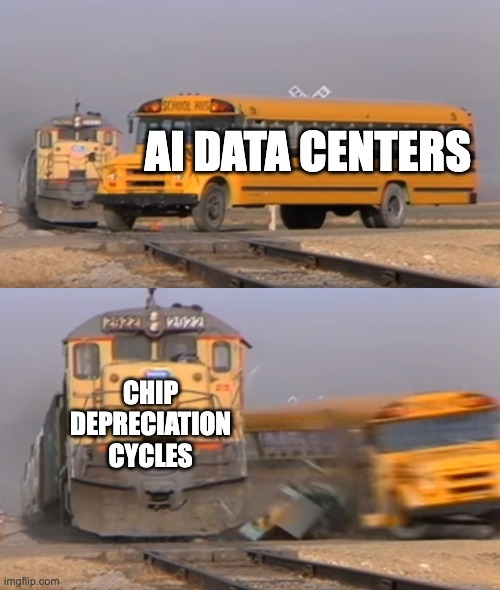
But when the AI bubble pops, or we fall into the trough of disillusionment — pick your favorite metaphor — there’s some tough math coming. Oversupply of infrastructure will meet slowing demand. But with the current pace of GPU development, what’s the chip depreciation cycle? Six years? Maybe four, or even two? I predict multiple years of unused capacity, making investments obsolete before they reach payback. Companies will be forced to write down these capital investments; if they’re lucky, they’ll squeeze a little more use out of them at lower prices.
I’m not the first one to compare this situation to the fiber optic buildout that turned into its own crash alongside the dot-com bust. But there, the assets remained useful: the dark fiber lit up years later as traffic increased again. Today’s GPUs may not be so lucky.
4. Data Quality Makes the Difference
I expect a surge of companies following the model of Labelbox, Scale AI, etc., all focused on high-quality, verifiable training data for specific use cases. Why?
The frontier labs will keep advancing general models, and I don’t see a serious challenge to the majors in 2026. Most companies are happy to innovate elsewhere while the researchers keep grinding. But as organizations move from experimentation to production, they're discovering that model quality for their specific needs depends heavily on domain-specific data. The next logical step will be for these organizations to look for ways to document, collect, label, and organize this data.
That means more action in this space. There will be more startups and probably more acquisitions, as we saw with NVIDIA and Gretel.
5. Apple Acquires a Smaller Frontier AI Lab
In 2026, I expect Apple to acquire one of the smaller but credible AI labs – e.g., Perplexity, Mistral, SSI, or Thinking Machines. The conditions are right on both sides of a potential deal.
Labs burn cash at extraordinary rates, and VC money won’t last forever. Investors will get antsy once the post-2025 high wears off, especially if they expect consolidation and want to get there first. While only a small number of companies are in a position to buy these labs …
… Apple is one of them, and probably the top one. It has plenty of cash. It’s made other acquisitions to enhance its internal capabilities (e.g., FoundationDB). Most importantly, it needs a better AI play to keep up with its competitors: Apple Intelligence is a joke.
Frequently asked questions